
After I left college, I knew I wanted to teach, and of all the subjects I had studied, history seemed the most important. This may surprise those who have not met me. You may ask, “Why does it matter when the Battle of San Jacinto happened during the Texas War of Independence?” But my experience has taught me that ignorance of history is growing, and its effects are only now becoming clear.
I started my teaching career by tutoring one student over Zoom during the COVID lockdowns around 2020. He struggled to remember facts and, more deeply, to care about school, often asking why he had to learn geometry or English. In reply, I gave him practical answers: people use geometry to build houses and decorate walls, they use English to write and speak well, and so on.
History gave him the most trouble, and that did not surprise me. Though history may be a core subject, it asks a lot of students: they must learn names and dates, memorize these facts, arrange them into a clear story, and apply that knowledge in essays, tests, and projects. Schools often made this harder by assigning coaches to teach history, even when some knew little more than their students.
For these reasons, it should not surprise us that many Americans know little history; if you doubt it, you can find dozens of videos and articles about this gap. A Gallup survey, for example, found that most American adults knew little about geography and world affairs, failing to answer half the history questions correctly. Even so, my student found ways to surprise me: he not only believed the Founding Fathers had iPhones but also could not understand what an invention was. He assumed the world had always had the tools he used every day; if his generation had iPhones, why wouldn’t everyone else have them too?
My student’s lack of knowledge may sound extreme, but many people think in the same way: they treat their own lives as normal, their own views as reason itself, and their own morals as the standard for everyone else. Most would deny this, yet the habit shows itself in daily life when they meet people from another culture and read foreign behavior through their own customs. If that fails, they may decide the whole society is mad, evil, or backward.
We do the same thing with people from the past. “The past,” as L.P. Hartley wrote, “is a different country.” Many people look back and force their own values onto earlier ages, while others dismiss the past as savage, as if nothing worth knowing happened before they were born. Then they call those older societies bigoted and prejudiced without seeing the irony.
Prejudice often begins with a weak imagination: when people cannot picture other lives clearly, they invent crude portraits instead. Those portraits may be false and dull, but they comfort the bigot; if people abroad or in the past were wrong and bad, then he can feel right and good. He does not have to think harder, life goes on, and nothing needs to change. The idea that the people he dismisses as primitive know something important could unsettle him or even change how he lives.
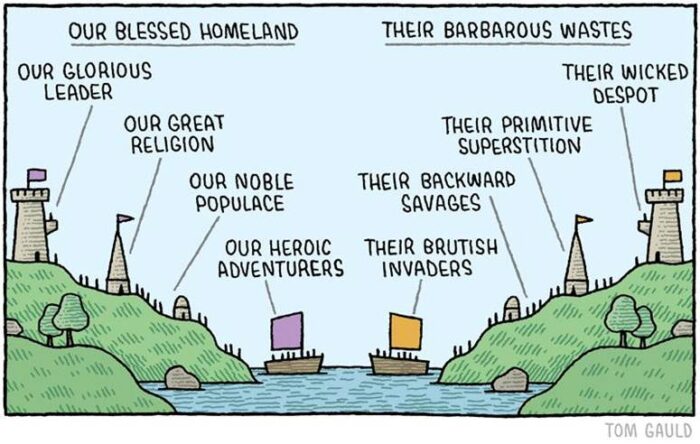
Even though many political movements promote inclusivity and authentic representation, people seem more divided than ever. The Internet fuels this divide by pulling us into echo chambers, flattening public debate, and rewarding outrage. The so-called “diversity” movement does little to fix this and often makes things worse by demanding conformity and cultural control. Its current approach seems to involve recasting figures such as Cleopatra, Anne Boleyn, and Helen of Troy as black despite the historical record. These choices have sparked discussion about other cultures, but the backlash suggests that few of those conversations have been useful.
A weak imagination also weakens art, especially when writers know little about the cultures they try to portray. Instead of writing with depth or care, they often turn those cultures into thin copies of modern society. Suspension of disbelief breaks when a fantasy writer gives elves a war council that sounds like a hearing in Washington, D.C., then uses the orcs as a clumsy stand-in for black Americans and calls it insight.
Anachronism, though, does not always fail. Shakespeare’s Julius Caesar puts a Big Ben-style clock tower in ancient Rome, a detail that helped bring old Rome closer to his audience while adding tension to the play. Because the clock made the setting easier to grasp and the characters easier to follow, the choice served the drama rather than weakening it. Hollywood epics such as The Ten Commandments and Spartacus used a similar trick by casting British actors as rulers and American actors as workers, slaves, and heroes. To American ears, the British accents made the upper-class villains sound refined but cold, while the American accents made the heroes sound familiar and warm. An author must know history before he bends it well, else he falls into the trap of clumsily trying to make his work “relevant” at the cost of realism.
History is not just names and dates; it tells us about people who lived in worlds strange to us and helps us understand other cultures and ways of thinking. That is why it has real moral worth. People often repeat the phrase “learn from the mistakes of the past,” but history can teach more than failure: it can also show us what earlier people got right.
I return once more to my student, who has just turned sixteen and will soon graduate from high school old enough to vote. I have done what I can to help him learn history and judge more clearly, yet I remain only one voice among many. Some people would rather not teach history at all; they would rather leave the public easy to flatter, easy to fool, and stuck in the present. By teaching us to see the past through the eyes of those who lived it, careful study of history can enlarge both the mind and the heart.
Leave a Reply